Aungsha Editorial
What Is Fractional Real Estate Investment? A Complete Guide for Bangladeshi Beginners
Real estate has historically given good long-term returns, but the traditional path locks up large sums of money for years.
Imagine you see the price of a flat in Dhanmondi or Bashundhara and think, "I can never save that much money." You are not alone in this thought. For most people in Bangladesh, buying a full property means years of saving, heavy loans, or leaning on family support.
This is exactly where fractional real estate investment opens a different path. Instead of buying a whole property, you join other investors to buy a small share of it and earn profit based on that share. This model has already changed how people invest in developed countries, and it is now slowly becoming relevant in Bangladesh too.
In this guide, we will cover what fractional real estate investment really means, how it works, its benefits and risks for Bangladeshi investors, and how you can get started safely.
One thing worth noting: most Bangladeshi families keep their savings in fixed deposits, gold, or land. These assets are either low-earning or hard to turn into cash quickly. Real estate has historically given good long-term returns, but the traditional path locks up large sums of money for years. Fractional investment changes this equation. It lets you take part in real estate with whatever you have on hand, while keeping the rest of your savings free for other needs.
What Is Fractional Real Estate Investment?
In simple terms, fractional real estate investment means owning a part of a property instead of the whole thing. Think of it like buying shares in a company. The only difference is that here, you are becoming a part-owner of a building or commercial space instead of a business.
Here's how it works: a group of investors pool their money together to buy a property. Each person's share of ownership depends on how much they invest. If the property earns rental income or increases in value, every investor receives a share of the profit based on their portion.
This is different from buying a flat outright, where you must pay the full amount at once and handle all the responsibilities of the property yourself. It is also different from a [Real Estate Investment Trust (REIT)], where you buy shares in a company that manages a large portfolio of many properties, but you don't directly own any specific one. With fractional ownership, you usually know exactly which property your money is in, for example, a specific residential building in Dhaka or a commercial unit in Chattogram.
Here's an example to make it clearer. Say a six-story residential building in Uttara costs several crore taka. In a fractional model, this building could be divided into hundreds of shares, each representing a tiny percentage of ownership. Even someone with a small amount of money becomes a real part-owner of this building and gets a fair share of the rental income and value growth. This is not like lending money to a developer you hold real, documented, and tracked ownership in an actual property.
How Fractional Real Estate Investment Works
The process sounds complicated, but in reality it's much simpler than it seems.
Step 1: Choose a Platform Investors use a [digital real estate platform] or real estate crowdfunding site that finds, verifies, and lists properties. The platform handles the legal paperwork and management.
Step 2: Select a Property Every listed property comes with details about its location, expected returns, minimum investment amount, and holding period. You review these details and pick a property that matches your goals.
Step 3: Invest What You Can Afford Instead of paying the full property price, you invest a share based on what you can afford. Some platforms let you start with just a few thousand taka.
Step 4: Earn Proportional Returns If the property earns rental income or its value increases, you receive profit based on your share. This is usually paid out at regular intervals or when the property is sold.
The practical, day-to-day work, managing tenants, maintenance, and legal compliance is handled by the platform or its team. You don't need to worry about finding tenants or fixing a leaking roof.
Liquidity, meaning how easily you can access your money, is where the biggest difference from traditional property ownership shows up. Some platforms let you sell your share to another investor on a secondary market, while others require you to wait until the property itself is sold. So it's important to understand a platform's exit terms clearly before you invest.
Benefits for Bangladeshi Investors
Start With a Small Investment This is the biggest draw. You can begin [low-budget real estate] investing without gathering lakhs or crores of taka, and grow your portfolio gradually over time.
Risk Diversification Instead of putting all your savings into one property, you can spread small amounts across different properties in Dhaka, Sylhet, or Chattogram. So if one investment underperforms, the damage to your overall portfolio stays limited.
Passive Income Potential Rental income is distributed among investors, so you don't have to deal with tenants or paperwork yourself.
No Management Hassle Property managers take care of maintenance, tenant issues, and daily operations.
Easy Access for Expatriate Bangladeshis Buying and managing property back home has always been difficult for Bangladeshis living abroad. They either had to rely on family or handle complicated paperwork from a distance. Fractional platforms make it possible for expatriates to invest in Bangladeshi real estate remotely, with proper documentation and digital tracking.
Currency Risk Management Some platforms also allow investment in international fractional properties, which can act as a hedge against taka depreciation.
Tax Efficiency Depending on the structure, fractional investment can sometimes be more tax-efficient than direct property ownership, since costs like registration and stamp duty are shared among all investors. It's wise to consult a tax expert before investing.
Build a Portfolio Faster Because the entry cost is low, you don't need to wait years to buy one large property. Every time you have extra savings, you can add a new property to your portfolio much faster than the traditional one-property-at-a-time approach.
Risks and Challenges
No investment is risk-free, and fractional real estate is no exception.
Market Risk: Property values can fall due to economic conditions, oversupply, or local factors, the same risk that applies to traditional ownership.
Platform Risk: Your investment is only as reliable as the platform managing it. A poorly run or unregulated platform can create serious problems.
Liquidity Risk: Not all platforms offer quick or guaranteed exits. Withdrawing money in an emergency can be difficult.
Regulatory Uncertainty: Bangladesh currently has no complete regulatory framework specifically for fractional real estate platforms. This means the investor protections common in more developed markets are not yet fully established here.
Currency Risk: If you invest in international property, currency fluctuations can affect your actual returns.
Understanding these risks doesn't mean avoiding the investment — it means doing thorough research before putting in your money.
Fractional vs. Traditional Real Estate Ownership
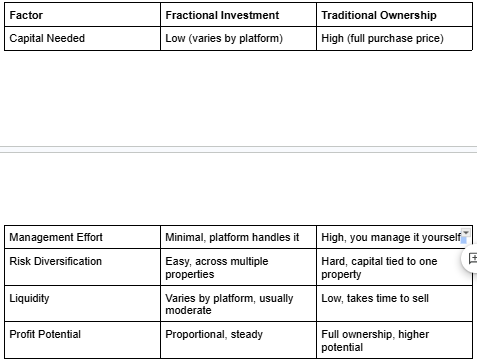
If you're a new investor, want risk diversification, or want to avoid hands-on management, fractional investment is a good option. But if you have enough capital, want full control over a property, or plan to live there yourself, traditional ownership may suit you better.
Getting Started: Steps for Bangladeshi Beginners
Research platforms. Compare local and international platforms suitable for Bangladeshi investors. Look at their track record, transparency, and property verification process.
Define your goals and risk tolerance. Decide whether you're investing for passive income, long-term value growth, or portfolio diversification.
Start small. Treat your first investment as a learning experience. A limited amount helps you understand how profit, reporting, and exits work before committing larger sums.
Monitor your portfolio regularly. Keep track of rental distributions, property performance updates, and any changes in platform policy.
Consider tax implications. Discuss with a tax expert how income from fractional real estate investment is taxed under Bangladeshi law.
Join an investor community. Online forums and local investor groups can help you learn from others' experiences and avoid common mistakes.
The Regulatory Environment in Bangladesh
Fractional real estate investment is still a new concept in Bangladesh, and its regulatory framework is developing gradually. Unlike listed stock markets, which fall under the Bangladesh Securities and Exchange Commission, there is currently no specific oversight system for fractional property platforms.
This is exactly why checking a platform's legitimacy before investing is so important. Choose a platform that verifies property ownership and legal documents before listing, keeps clear records of your ownership share, and communicates openly about risks and returns. As the sector matures, clearer rules are likely to emerge, just as they have for other new investment models.